RankAbove logo — purple pulse-line mark with animated teal dot, next to white 'rankabove' wordmark

October 1, 2026

If you’re trying to improve search visibility, Google Search Console gives you the significant starting point most optimization work needs: the queries already surfacing your pages, along with impressions, clicks, CTR, average position, indexing status, and now direct reporting on impressions from AI Overviews and AI Mode.

Get a Ground Truth Dataset: Start With Your GSC Data (it’s free)

There are plenty of ways to check AI search visibility. You can run relevant questions through ChatGPT, Gemini, or Perplexity, see whether your brand appears, note which pages get cited, and repeat the exercise over time. I put together a simple AI search visibility framework and worksheet for doing exactly that.

Today, Google Search Console adds an essential view of data from Google itself. Its Performance report shows impressions, clicks, CTR, average position, and the queries and pages producing that activity. You can compare those results across dates, devices, countries, and other dimensions.

Before you make a change to an important webpage, it just makes sense to record its current performance. If you don’t measure first, you can’t accurately gauge the benefits or drawbacks of the change you’re implementing.

That sounds obvious, but it changes the quality of the decision you’re about to make.

The Same Numbers Can Mean Different Things for Different Pages

Imagine two pages: One has 20,000 impressions and a 0.8% CTR. Another has 300 impressions and a 5% CTR. Those numbers don’t tell you that either page is healthy or unhealthy on their own. Position, query intent, and the searches producing those impressions all matter.

But they immediately give you better questions. The first page already has substantial exposure. Why are relatively few searchers clicking? The second gets far fewer opportunities to earn a click. Does it need stronger relevance for the queries that matter, better internal linking, more authority, or something else entirely?

Search Console helps you see that difference before an optimization tool tells you to rewrite both pages.

That becomes particularly useful when you’re managing a large site. I use the same idea in How to Audit Content in the Age of AI Search. Existing search performance is useful evidence when deciding whether a page deserves a rewrite, an expansion, consolidation, or simply more time.

Google Now Shares First Party AI Search Visibility Data
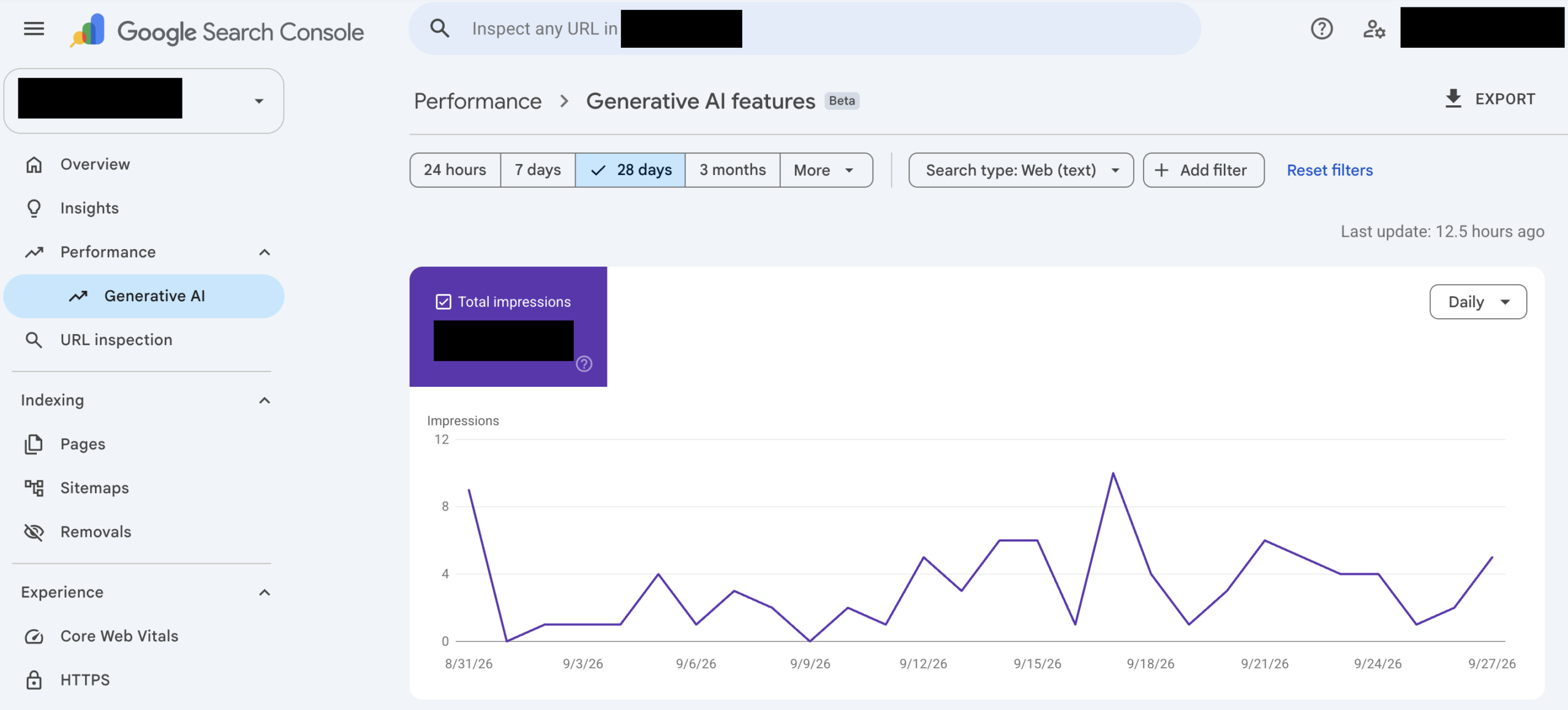
A screenshot of Google Search Console's generative AI performance report showcasing impressions earned from Google's AI-generated search experiences including AI Overviews and AI Mode searches, displaying a chart over time.

In 2026, GSC became much more useful for AI search specifically. Google’s Generative AI performance report shows impressions from AI Overviews and AI Mode. You can see how those impressions change over time, which pages receive them, and where they come from by device and country. Google says the report is now available worldwide.

That gives marketers and SEO teams a direct answer to a question that used to be much harder to investigate:

Which of my pages is Google actually surfacing inside its generative search experiences?

You can then compare pages, watch trends, and see whether the pages you’re actively working on are gaining or losing AI-search exposure.

Search Console Is Expanding With Search Itself

Google has also begun reporting multimodal search activity, including searches involving Lens, Circle to Search, image uploads, and Chrome’s image-search feature. Those signals are appearing in both the standard Performance report and the Generative AI report.

That matters because search behavior is spreading well beyond the traditional typed query. Search Console is becoming a place where you can see more of those discovery paths together instead of treating every new search interface as an entirely separate world.

The AI Report Gives You Something Concrete to Track

The current Generative AI report is centered on impressions. It tells you that links from your site were shown in Google’s generative Search features and lets you track that visibility over time. That creates some very practical uses.

If you optimize ten important pages, you can watch which ones begin earning more AI impressions. If one section of your site consistently receives more exposure than another, you’ve got something worth studying. If AI visibility changes after a major content update, you’ve got a date and a measurable trend to compare.

You can also compare that information with the rest of your Search Console data instead of evaluating AI visibility in isolation.

More detailed generative-search engagement reporting is also due for UK publishers under the CMA’s Google Search requirements later this year. Learn more about this in my article from earlier this year: Google Legally Required to Add AI Visibility Features: Here’s What’s Coming and When.

GSC Can Tell You What to Investigate Before You Rewrite

Some of the most useful information in Search Console has nothing new or exotic about it: Is the page indexed? Which canonical URL did Google select? Can Google crawl it correctly? Which queries already show the page? Those checks can save a lot of wasted optimization work.

Google’s current guidance says pages need to be indexed and eligible to appear in normal Search with a snippet to qualify as supporting links in AI Overviews and AI Mode. Existing SEO fundamentals still apply. Google also says there isn’t any special AI schema, markup, AI text file, or required content format that unlocks these features.

So if an important page isn’t indexed, there’s a clear place to start. If Google has chosen a different canonical URL, that deserves attention. If the page already performs strongly for a group of valuable queries, you know what existing visibility you want to protect while improving it.

You Can Also Control Whether Google Uses Your Site in Generative Search

Search Console now includes a Search generative AI control under Settings.

Site owners can choose whether their links and content are eligible to appear in AI Overviews, AI Mode, and supported generative features in Discover. Inclusion is the default. Search Console also shows whether a property’s setting is inherited from a parent property.

That gives website owners something they’ve rarely had in the early stages of AI search: a direct control alongside direct reporting.

If AI search visibility is part of your strategy, checking that setting belongs alongside checking indexing and performance.

Measure What Happens After You Make the Change

The real benefit of establishing the starting point comes afterward.

Record what you changed and when. Once Google has recrawled the page, return to the same metrics. Look at impressions, clicks, queries, CTR, position, and AI impressions where available. You now have a before-and-after record.

Maybe a page begins appearing for more relevant searches. Maybe impressions rise while clicks stay flat. Maybe an important query loses visibility. Maybe Google’s AI impressions begin climbing while traditional Search remains steady.

Each result gives you a better next question, and better insight into what changes to your site actually move the needle for driving the search performance metrics you’re aiming for.

This is the measurement problem I explored in How Do You Know If Your AI Search Strategy Is Actually Working? Visibility, user behavior, and business impact are different layers of performance. Tracking them separately makes it much easier to understand what’s actually changing.

Connect Search Visibility to What Happens on the Site

Search Console gives you the pre-click side of the journey. Google Analytics gives you what happens after someone arrives.

Google recommends using the two together for exactly that reason. Search Console shows how people discover your site through Google Search. Analytics can show what those visitors do afterward, including engagement and conversions.

So if a page gains more visibility and more clicks, you can continue the investigation in Analytics. Did those visitors engage? Did they reach an important page? Did they complete a form, subscribe, or make a purchase?

I covered a broader version of that workflow in How to Get Better AI Search Data From Four Free Tools You Already Use, using GSC, GA4, Bing Webmaster Tools, and Microsoft Clarity together.

Different tools give you different pieces of the journey. That’s useful when you know what question you want each one to answer.

A Simple GSC Routine for Search Optimization

For any page important enough to optimize, I’d capture five things:

    1. Indexing and canonical: Is the page indexed, and is Google using the URL you expect

    2. Existing visibility: Which queries show the page, and what are its impressions, clicks, CTR, and average position?

    3. AI visibility: Is the page receiving impressions in Google’s Generative AI report?

    4. The change: What did you change, and when did it go live?

    5. The result: What happened to those same signals after Google re-crawled the page?

That creates a simple record of the page before and after the work.

Do this consistently and you start building something more valuable than a list of SEO or AI-search recommendations… You start building your own evidence about what tends to improve performance on your site.

Google Data Fits Into a Bigger AI Search Picture

Search Console covers Google. Other tools can show you what’s happening elsewhere. That’s where AI visibility monitoring becomes useful. You may want to know whether ChatGPT mentions your company, whether Perplexity cites a competitor, what sources Claude uses, or how your visibility changes across different answer engines. Those observations can sit alongside the first-party data coming from Google instead of replacing it.

I explored that distinction in What Google’s AI Search Guide Won’t Tell You. Google’s guidance tells us a great deal about succeeding in Google’s systems. Other AI search environments give us additional questions to investigate.

Why RankAbove Uses GSC as a Baseline

This is why Google Search Console plays an important role inside RankAbove. We use its first-party Google Search data as a baseline for the pages we analyze. That means recommendations provided by the platform can be considered alongside the visibility a page already has, the queries already showing it, its technical status, AI-search signals, and the changes that have previously been made.

A page with valuable existing visibility should be treated with that history in mind. A page with an indexing problem deserves a different recommendation. Once a user approves and implements a change, its subsequent performance becomes another piece of evidence for what RankAbove recommends next. The result is an always-improving playbook for SEO and AI search visibility.

The result is a much more useful loop:

See what the page is doing → decide what to change → make the change → measure what happens → use that evidence the next time.

The person using RankAbove still decides which recommendations make sense, which to change, add, or remove, and which changes go live. Humans set the strategy. AI tracks it all for you. Read more about ethical AI tools that put humans first in The AI You Choose Is a Vote for the Future of Marketing.

The opportunity I see in AI search isn’t simply getting machines to make more decisions for us. It’s giving the people responsible for search better information, faster feedback, and a clearer view of what happens when they act.

Google Search Console gives us one very useful part of that evidence. If you don’t use GSC today, you can create a free account and connect it to your website in minutes.

How to Become a Preferred Source in Google’s AI Overviews

Since you made it this far, here’s a “treat” to kick off your October festivities: Google now lets users choose which websites they want to see more often in its AI generated search results. To allow users to choose your site as a preferred source, it’s as simple as adding a small button on your page. If someone selects your site as a preferred source, your content can be highlighted with a “preferred” badge in AI Overviews, AI Mode, and Top Stories results.

Help your readers find your site through preferred sources in Google Search here.

About the Author

Don Pingaro is Regional Marketing Director, North America at Fulcrum Digital and author of The AI Search Brief, where he discusses AI search strategies, customer experience, marketing technology, and the changing role of the people responsible for all three. He also manages R&D and go-to-market strategy for RankAbove.ai.

Subscribe to the AI Search Brief here.

Related Articles from The AI Search Brief

Additional Sources

AI Bots Read More Than They Refer: What Marketers Should Know

AI crawlers have developed a big appetite. The clicks they send back have not kept pace.

Cloudflare’s 2025 traffic data gives marketers a useful way to think about that gap: the AI crawl-to-referral ratio. It compares how often an AI or search platform requests HTML pages with how often that platform refers a person back to a website.

The takeaway is not to block every bot or chase every new optimization trick. It is to measure machine discovery and human response as two related, but different, outcomes.

The numbers are a little wild

In its 2025 Radar Year in Review, Cloudflare reported that AI bots generated an average of 4.2% of HTML requests across its customer base. Googlebot alone accounted for 4.5%.

The gap between crawling and referrals varied dramatically by platform. Anthropic’s ratio settled mostly between roughly 25,000:1 and 100,000:1 after May. OpenAI peaked near 3,700:1 in March. Perplexity finished much lower, generally below 200:1 from September onward.

One important caveat: native apps may not always pass referral information, so some AI-driven visits can be undercounted. Cloudflare also describes this ratio as volatile. It is a directional signal, not a tidy scoreboard.

21×

User-action crawler traffic grew more than 21 times from January through early December 2025. That is crawling tied more closely to a person’s request, rather than background model training.

What might the crawl-to-referral gap mean?

1. Visibility may happen before the click

An AI answer can mention a company, summarize its product, or quote its research without producing a conventional website session. That makes citations, accurate representation, and share of answer useful companions to rankings and traffic.

2. Referred visitors may arrive with stronger intent

This is a theory worth testing, not a universal rule. If an answer engine handles early research, a person who clicks through may be closer to comparing, validating, or buying. Smaller traffic numbers could still carry meaningful business value.

3. Original information becomes more valuable

Generic summaries are easy to reproduce. First-party research, product details, expert explanations, clear policies, and current documentation give both people and answer engines a reason to use a specific source.

The useful question is not, “Did a bot visit?” It is, “Did our content become the clearest source for the next human decision?”

Retail and software may feel the shift first

Cloudflare found that retail and computer software together attracted just over 40% of AI crawler activity in October 2025. That concentration suggests a few practical possibilities.

A practical SEO, AEO, and GEO checklist

Google’s official guidance for generative AI features says that foundational SEO still matters. Google recommends crawlable pages, sound technical structure, useful original content, and a good page experience. It also says no special AI markup or llms.txt file is required for visibility in Google’s generative search features.

Microsoft’s Bing Webmaster guidance adds a helpful content layer: use clear headings, tables, and FAQ sections; support claims with evidence; reduce ambiguity; and keep important information current.

  1. Stay discoverable. Check indexing, robots directives, canonical URLs, sitemaps, and JavaScript rendering.
  2. Answer the real question early. Lead each important section with a direct, useful response, then add context.
  3. Make claims easy to verify. Link to primary sources, name methodologies, show dates, and distinguish facts from theories.
  4. Use structured data honestly. Add supported schema when it accurately describes visible page content. Validate it before publishing.
  5. Keep brand facts consistent. Product names, pricing, locations, leadership, and policies should agree across owned channels.
  6. Measure both sides. Track organic traffic and conversions alongside citations, cited pages, referral sources, and brand accuracy in AI answers.

The short version

AI systems are reading a great deal of the web, and referral traffic tells only part of the story. Marketers do not need to abandon SEO or redesign every page for a mysterious machine audience. The sensible move is to publish distinctive, well-structured information, make it easy to verify, and measure whether search and AI experiences represent the brand accurately.

In other words: keep earning the click, but start paying attention to the answer that comes before it.

Reporting bugs and getting help

RankAbove is in active beta development, and feedback moves fast. Here is how to report a bug, ask a question, or request a feature.

The Feedback button

Tap the purple "Feedback" button in the bottom right corner of any page. Questions, comments, and bug reports all go through the same channel, and the team gets back to you right away.

Writing a useful bug report

Three things make a report actionable: what you did (the page and the action), what you expected, and what happened instead. Include the site and page URL involved; if the problem is visual, a screenshot saves a round trip.

Tip

If an analysis fails or returns something strange, note the exact page URL you analyzed and the approximate time. That lets the team find the run in the logs directly.

Feature requests

Feature requests go through the same Feedback button. Beta feedback genuinely shapes the roadmap, so describe the problem you are trying to solve rather than only the feature you want built.

Self-serve help

The Help Articles in the left navigation cover setup, the analysis workflow, integrations, and results. For everything else, check www.RankAbove.ai/support or reach out through the Feedback button.

AI Search Visibility Report 2026

How brands are being cited, or ignored, across ChatGPT, Gemini, Perplexity, Claude, and Grok. Data from 50,000 AI-generated responses across 12 industries.

How brands are being cited, or ignored, across ChatGPT, Gemini, Perplexity, Claude, and Grok. Data from 50,000 AI-generated responses across 12 industries.

The 2026 AI search landscape

AI-generated answers now sit between your content and your audience. When a buyer asks ChatGPT, Gemini, or Perplexity a question your page could answer, the engine composes a response from the handful of sources it trusts, and every source that is not cited is invisible.

This report measures that selection process directly. Across 50,000 AI-generated responses, we recorded which brands were cited, which were ignored, and what separated the two.

The citation gap

Citation share is winner-take-most. In every category we studied, a small group of brands captured the majority of citations while the rest split the remainder, a distribution far more concentrated than traditional search rankings.

Just 11% of brands account for 64% of AI citations. The engines have already picked their trusted sources, and they keep going back to them.

The gap compounds: cited sources gain authority signals that make future citations more likely. Brands that establish citation presence early are becoming structurally difficult to displace.

What earns citations

Comparing cited pages against ignored ones with equivalent rankings, four signals separated winners from losers:

Notably, traditional ranking position explained less than half of citation behavior. Strong SEO gets you considered; these four signals get you chosen.

Industry breakdown

Citation concentration varies by vertical. Software and finance show the tightest winner circles; travel and consumer goods remain comparatively open, with citation share still contested.

For brands in concentrated categories, the report details the displacement strategies that worked: targeting long-tail question clusters first, building citation density on comparison pages, and correcting brand misrepresentation before competing head-on.

Methodology

Between October 2025 and February 2026, DataLab issued 10,000 structured queries across ChatGPT, Gemini, Perplexity, Claude, and Grok, five times each, and recorded every cited source. Queries were drawn from real buyer questions across 12 industries, and citation attribution was verified against page-level crawl data.

GEO Benchmark Report: Q1 2026

Generative Engine Optimisation benchmarks across 8 industry verticals. Which content signals drive AI citations, and which are myths.

Generative Engine Optimisation benchmarks across 8 industry verticals. Which content signals drive AI citations, and which are myths.

How the benchmark works

The GEO Benchmark tracks a fixed panel of 25,000 buyer-intent prompts across five AI engines each quarter, recording every source cited in every response. Because the prompt panel is stable, quarter-over-quarter movement reflects real shifts in engine behavior rather than changes in what we asked.

Citation rate — the share of relevant prompts on which a brand is cited at least once — is the benchmark’s core metric.

Vertical results

Software and B2B services show the highest median citation rates, driven by dense comparison content and mature schema adoption. Finance sits at the other extreme: high citation volume, but concentrated in a handful of incumbent sources.

Finance is effectively closed — five brands take 71% of citations. Travel is still wide open: no brand holds more than 9%.

For challengers, the open verticals are the opportunity. Citation share that will be structurally hard to win in 2027 is still cheaply available in travel, consumer goods, and healthcare services today.

Signals that matter — and myths

Regressing citation outcomes against page-level characteristics across all eight verticals:

Using the benchmark

Benchmark your citation rate against your vertical median, not a global average — a 6% rate is dominant in travel and mid-pack in software.

Methodology

Between January 2 and March 10, 2026, DataLab issued the 25,000-prompt panel to ChatGPT, Gemini, Perplexity, Claude, and Grok, three times each, and recorded all cited sources. Vertical assignment follows each brand’s primary category; sources cited fewer than three times were excluded from concentration figures.

Answer Engine Optimisation: The 2026 Practitioner Guide

Practical AEO techniques for structured content, schema deployment, and direct-answer capture across AI assistants and featured snippets.

Practical AEO techniques for structured content, schema deployment, and direct-answer capture across AI assistants and featured snippets.

What AEO covers

Answer Engine Optimisation is the practice of shaping content so that engines can lift it directly into an answer — a featured snippet, an AI assistant response, or a voice result. Where SEO competes for a position on a results page, AEO competes for the words inside the answer itself.

The two disciplines overlap but diverge in emphasis: AEO cares less about where a page ranks and more about whether any single passage on it can stand alone as a complete, attributable answer.

Structuring pages for direct answers

Four structural patterns account for most answer capture in our data:

Write the answer a machine could quote verbatim without embarrassment. That passage is the unit of AEO.

Schema deployment

Structured data tells the engine which passages are answers. FAQPage markup on genuine question-and-answer content, HowTo on procedural content, and Speakable on passages suited to voice give extractors an explicit map — and every answer-bearing page should carry Article and Organization markup underneath so the answer arrives with clear provenance.

Deploy schema that mirrors visible content exactly. Markup that diverges from what users can see is discounted, and at scale it erodes the site’s credibility with extractors.

Measuring answer capture

Track answer capture as its own metric: for each target question, does the engine’s answer quote or cite your page? RankAbove’s citation tracking automates this check across engines and re-runs it on every optimization cycle.

SEO, GEO & AEO Page Anatomy: The Complete 2025 Guide

A verified, annotated anatomy of a page built to rank in Google, get cited by LLMs, and surface in AI-generated direct answers. Updated for 2025–2026.

A verified, annotated anatomy of a page built to rank in Google, get cited by LLMs, and surface in AI-generated direct answers. Updated for 2025–2026.

Three surfaces, one page

SEO gets you ranked, GEO gets you cited by generative engines, and AEO gets you quoted inside direct answers. Teams often treat these as three content programs; in practice they are three consumers of the same page, each reading it a different way.

The signals overlap far more than they conflict. A page built to the anatomy below serves all three surfaces without compromise, which is why we recommend building to it by default rather than maintaining separate variants.

The anatomy, top to bottom

Where teams go wrong

The recurring failures we see in audits are structural: answers spread across multiple paragraphs so no single passage stands alone, headings written for cleverness instead of queries, schema describing content that isn’t on the page, and author or organization identity that changes from page to page.

The most common failure isn’t bad content — it’s good content that no engine can lift cleanly.

Keeping it current

Extraction behavior changes quarterly as engines update their retrieval and grounding stacks. The anatomy is stable, but the weighting between its parts moves — dated freshness signals mattered little in 2024 and are now decisive on time-sensitive queries.

Why AI Overviews Are Rewriting the Rules of SEO in 2025

Google's AI Overviews now appear in 47% of searches. How they're changing click-through rates, which content formats still earn citations, and what your SEO strategy needs to look like right now.

Google's AI Overviews now appear in 47% of searches. How they're changing click-through rates, which content formats still earn citations, and what your SEO strategy needs to look like right now.

The 47% threshold

AI Overviews crossed from experiment to default this year. Across the 200,000 US SERPs we sample monthly, the share of queries returning an AI Overview rose from 18% to 47% in eighteen months — and the growth is concentrated exactly where content teams have invested most: informational, question-shaped, long-tail queries.

The result is a new layer between your rankings and your traffic. A page can hold position one and still sit below a full-width answer composed from other sources.

What happens to clicks

Comparing matched query sets with and without Overviews, position-1 organic click-through fell by roughly a third when an Overview was present. Positions two through five lost proportionally more.

The click didn’t disappear — it moved inside the answer. The only pages still winning are the ones the Overview cites.

Cited sources are the exception: pages linked inside the Overview held their referral traffic, and in several verticals grew it, as the citation itself became a new click surface.

Formats that still earn citations

Controlling for ranking position, four content characteristics separated cited pages from ignored ones:

What to change in your strategy

Rankings still matter — they define the candidate pool the Overview draws from. But ranking without citation is now a losing position on nearly half of all queries.

Methodology

Between November 2024 and April 2026, DataLab sampled 200,000 US search results monthly across 12 industries, recording AI Overview presence and cited sources. Click-through analysis draws on aggregated Search Console data from participating RankAbove sites, matched across Overview and non-Overview query sets.

AI Overviews and Your Traffic

Expand all Collapse all No matches found. Try different keywords. Welcome to RankAbove Onboarding Guide + Setting up your account The RankAbove dashboard Connecting your site Connecting Google Analytics The Analysis page Optimizing page content Page Rule Content Agent Structural Improvements Optimization Suggestions How often to refresh The Observatory Performance page Getting Started − Getting started checklist Requesting access and logging in SEO vs GEO vs AEO, explained What AI Overviews mean for your traffic The shift The new unit of visibility How to measure the impact How to respond How AI engines choose their sources Glossary of search and AI visibility terms Dashboard & Data + Reading your dashboard Understanding your SEO, GEO and AEO scores Accessibility and search visibility Managing sites, settings and integrations Managing users and roles Security and data privacy One view of SEO, GEO and AEO Troubleshooting your Search Console connection What GA4 data adds to your recommendations What is RankAbove's process for sourcing LLM citation data? Analyze & Optimize + Analyzing your first page Which pages should you optimize first? Reading the "What We’ll Optimize" slider Optimizing page content in the editor Using the Page Rule Content Agent Generating structural improvements and schema The 30-day optimization cycle Approvals, governance and rollback Publishing changes to your CMS Insights & Results + Tracking AI citations in the Observatory The Observatory beyond citations DataLab: the citation intelligence engine How RankAbove protects brand accuracy The eight citation pillars explained Reading the Performance page Exporting your data Account & Billing + Billing and plans Support + Reporting bugs and getting help Frequently asked questions What's new in RankAbove Help Center / Getting Started / What AI Overviews mean for your traffic Getting Started What AI Overviews mean for your traffic AI Overviews now appear across a large share of Google searches, and they change what a ranking is worth. Here is what that means for how you measure visibility.

Expand all Collapse all No matches found. Try different keywords. Welcome to RankAbove Onboarding Guide + Setting up your account The RankAbove dashboard Connecting your site Connecting Google Analytics The Analysis page Optimizing page content Page Rule Content Agent Structural Improvements Optimization Suggestions How often to refresh The Observatory Performance page Getting Started − Getting started checklist Requesting access and logging in SEO vs GEO vs AEO, explained What AI Overviews mean for your traffic The shift The new unit of visibility How to measure the impact How to respond How AI engines choose their sources Glossary of search and AI visibility terms Dashboard & Data + Reading your dashboard Understanding your SEO, GEO and AEO scores Accessibility and search visibility Managing sites, settings and integrations Managing users and roles Security and data privacy One view of SEO, GEO and AEO Troubleshooting your Search Console connection What GA4 data adds to your recommendations What is RankAbove's process for sourcing LLM citation data? Analyze & Optimize + Analyzing your first page Which pages should you optimize first? Reading the "What We’ll Optimize" slider Optimizing page content in the editor Using the Page Rule Content Agent Generating structural improvements and schema The 30-day optimization cycle Approvals, governance and rollback Publishing changes to your CMS Insights & Results + Tracking AI citations in the Observatory The Observatory beyond citations DataLab: the citation intelligence engine How RankAbove protects brand accuracy The eight citation pillars explained Reading the Performance page Exporting your data Account & Billing + Billing and plans Support + Reporting bugs and getting help Frequently asked questions What's new in RankAbove Help Center / Getting Started / What AI Overviews mean for your traffic Getting Started What AI Overviews mean for your traffic AI Overviews now appear across a large share of Google searches, and they change what a ranking is worth. Here is what that means for how you measure visibility.

The shift

When Google shows an AI Overview, the generated answer sits above the traditional links, and it satisfies many searchers before they ever scroll. Click-through rates for the top organic positions drop sharply when an Overview is present. Ranking first no longer guarantees the visit.

The new unit of visibility

Inside an Overview, visibility belongs to the cited sources , the handful of pages the AI drew from. Being one of them puts your brand inside the answer; being absent makes even a first-place ranking invisible for that query. Citation share is becoming as important as rank.

How to measure the impact

Watch for the signature pattern in your Performance page: impressions holding steady while clicks decline . That usually means Overviews are absorbing clicks on queries you still rank for. Then check the Observatory: if you are not being cited on those queries, that is the gap to close.

How to respond

Identify your highest-value queries where an Overview appears, analyze the relevant pages, and prioritize the citation-factor recommendations: quotable statements, structured data, and factual precision. The goal shifts from winning the click to being in the answer, and capturing the clicks that remain.