RankAbove logo — purple pulse-line mark with animated teal dot, next to white 'rankabove' wordmark

The two roles

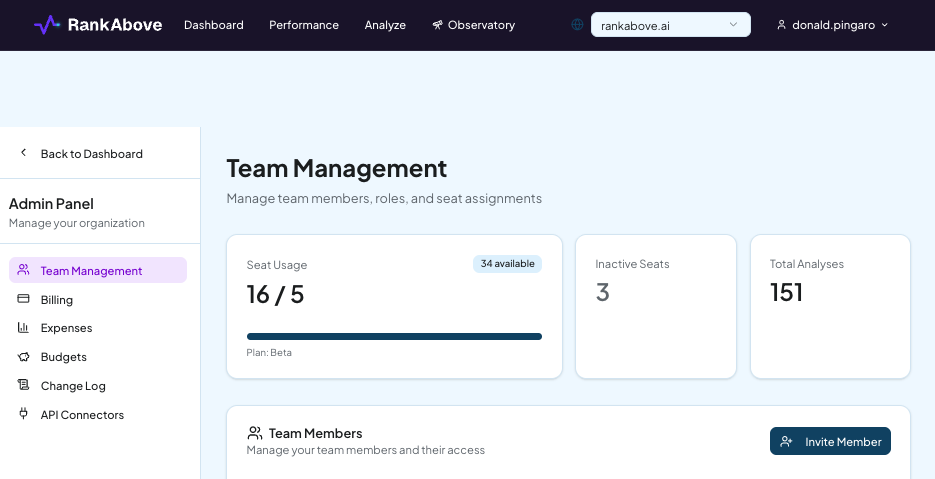
RankAbove keeps roles deliberately simple. Every account has exactly two kinds of users: the Admin, the first account created on the instance, and Members, anyone the Admin invites afterward. What a Member can do is entirely configured by the Admin, and it depends on whether you are using RankAbove solo or as a team.

Solo, before you add a team

If you have not invited anyone else, you are the Admin by default, and every capability on this page belongs to you alone. As a solo user, you can:

Team plan (up to 5 users)

Once you invite others, you move to a Team account, currently capped at five users: one Admin plus up to four Members. The Admin keeps every solo capability above, plus control over each Member individually:

Integrations stay with the Admin on a Team account as well; see below.

What Members can do

Two settings, configured per Member by the Admin, determine what a Member's day-to-day looks like.

Which pages they can analyze. A Member can either analyze any page category with no Admin approval needed, or be limited to only the categories the Admin has assigned them. A Member can request additional pages beyond their allocation; depending on how the Admin has configured overages, that request is either approved automatically up to an allocated budget, or requires the Admin's sign-off.

Whether their changes need approval. A Member can either make changes with no approval needed, or must request changes that the Admin allows, denies, or modifies before anything ships.

Good to know

Both settings are configured per Member, so two people on the same team can work under different levels of autonomy.

Integrations and billing stay with the Admin

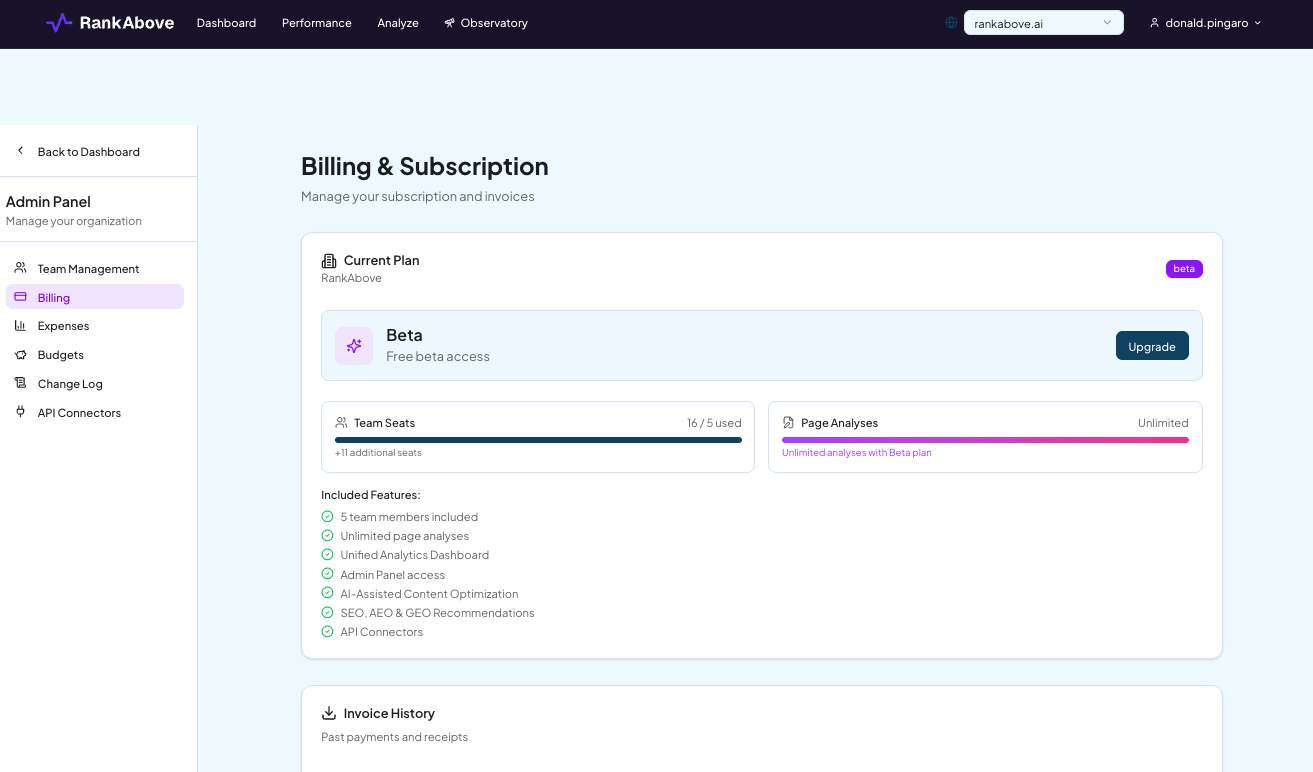
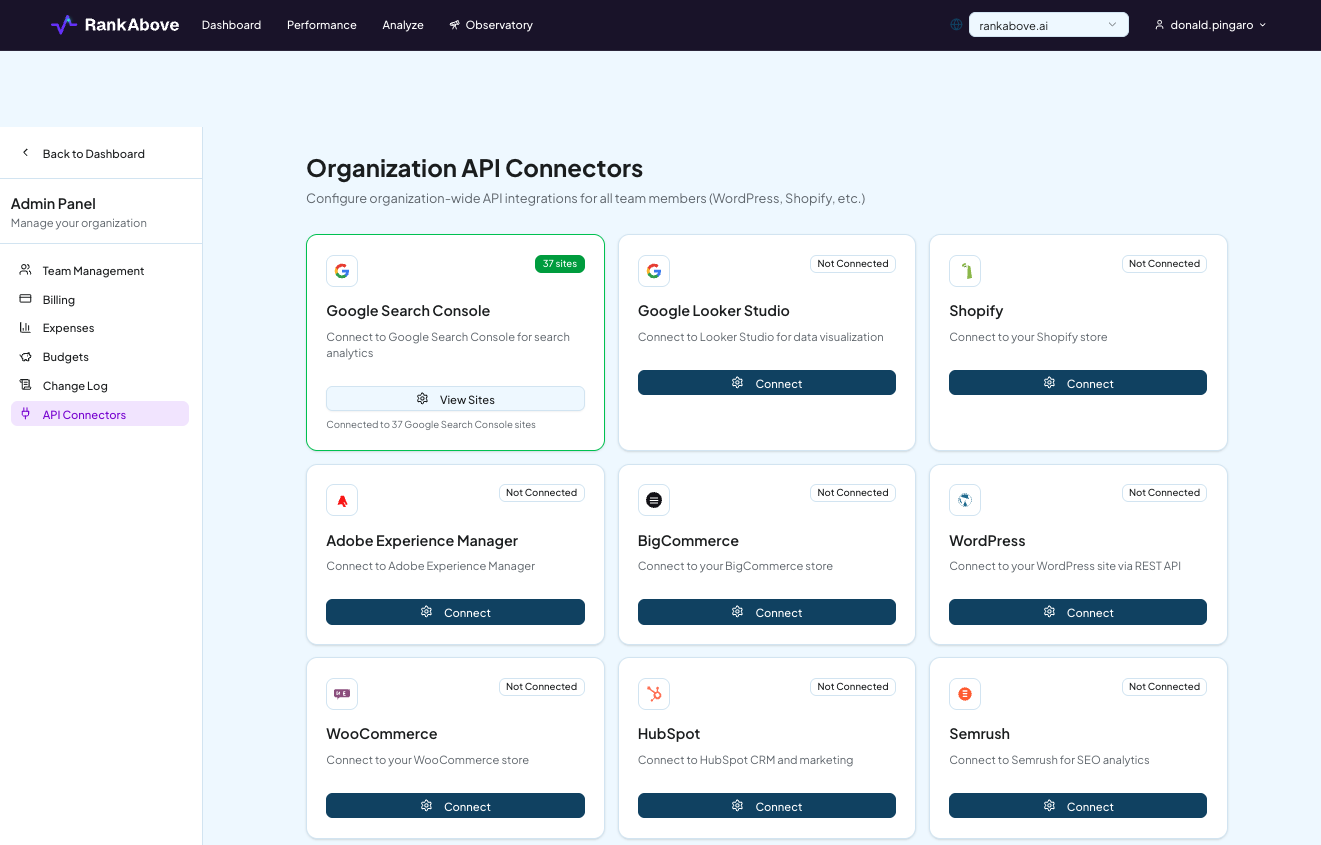
Regardless of solo or team use, two things never delegate to a Member. Billing: only the Admin can add, change, or remove the account's credit card, upgrade the plan, or cancel it. Integrations: only the Admin can connect the account's site, Google Search Console, Google Analytics 4, Shopify, Drupal, WordPress, Adobe Experience Manager, Adobe Commerce, Magento, and other platforms as they become available.
Tracking team activity

The Admin Panel's Change Log gives the Admin an audit trail of activity across the account, so growing a team does not mean losing visibility into what changed and when.

Coming Q4 2026: Agency access

An Agency tier is planned for teams managing multiple clients: a super-admin level that oversees multiple company-level Admins, each managing their own Members. Agency access is slated for release in Q4 2026.
Finding your settings

Click your name in the top right corner of any RankAbove page and select "Settings" from the dropdown menu. The page is organized into three tabs: Profile, Sites, and Integrations.

Profile

The Profile tab is where you update your name, email, and password. Changes take effect immediately, no confirmation email required for name changes, though password changes will always ask you to re-enter your current password first.

Adding and removing sites

From the Sites tab, tap "Add Site", enter your domain, and confirm. Each site appears in the list with its connection status. To remove a site, use the menu at the right of its row, removing a site does not delete its historical analysis data until you confirm a second time.

Before you start

Every site needs Google Search Console connected before RankAbove can analyze it. Have your GSC credentials ready when you add a new domain.

Integrations

The Integrations tab lists your connected data sources. Google Search Console powers ranking and query data; Google Analytics 4 adds traffic, attribution, and engagement context. Connect each with its "Connect" button and follow the sign-in prompts.

Heads up

If you see a browser warning during the Google sign-in flow, remember RankAbove is still in beta, click "Advanced" to proceed. A success message confirms when the connection is complete.

The standard we score against

RankAbove evaluates pages against the latest Web Content Accessibility Guidelines (WCAG), the standard published by the W3C. We will not restate the guidelines here; the linked specification is the authoritative source, and your accessibility score reflects how well a page aligns with it.

People first, machines too

Accessible pages are built on machine-readable structure: semantic markup, descriptive text for images, and content that reads in a logical order. That structure is what screen readers, e-readers, and other assistive technologies used by people with physical, mental, or other disabilities rely on to present your content.

The same structure is exactly what crawlers, scrapers, and indexing systems read. A page that is legible to assistive technology is legible to the machines that decide what ranks, what gets cited, and what becomes the answer.

The SEO, GEO and AEO connection

That is why accessibility work is not only a quality of life improvement for your customers. Focusing on accessibility most likely directly affects your likelihood of being ranked (SEO), cited in AI platforms (GEO), and chosen as the direct answer (AEO). It is one of the rare investments that compounds across every layer of search at once, which is also why it factors into your overall score.

Review before you implement

Please note

RankAbove is not responsible for improving ADA compliance, or for any particular customer’s ADA compliance. Our platform does its best to ensure all recommendations regarding accessibility are based in fact, but they should be reviewed and verified by a qualified professional on your side before they are implemented.

Treat RankAbove's accessibility recommendations the way you treat its content recommendations: a well-researched starting point that goes through your own review and approval workflow before anything ships.

The overall score

Your overall score is a weighted blend of the four pillars below. It answers one question: how findable is this page today, in traditional search results, in AI-generated answers, and for every visitor regardless of ability. A score above 80 means the page is fundamentally healthy; below 60 means there are gaps actively costing you visibility.

Scores are recalculated every time you run an analysis, so you can measure the impact of each round of changes.

SEO, ranking factors

The SEO score covers classic search engine ranking factors: title and meta quality, heading structure, internal linking, page speed signals, and keyword coverage against the queries your page already appears for in Google Search Console.

Good to know

SEO scores are most accurate when Google Search Console is connected, without it, RankAbove can only evaluate on-page factors.

GEO, citation factors

The GEO score measures how likely large language models like ChatGPT, Claude, Gemini, and Perplexity are to cite your page when generating answers. It weighs factual density, quotable phrasing, source clarity, and how your content compares to pages that are already being cited in your category.

AEO, direct answer factors

The AEO score reflects your likelihood of being chosen as a direct answer, a featured snippet, an AI Overview, or a one-line assistant response. Concise definitions, structured data, and question-shaped headings all raise this score.

Accessibility

The accessibility score checks your page against ADA compliance standards, contrast, alt text, semantic structure, and keyboard navigability. Accessibility issues factor into overall performance, so fixing them lifts more than one number.

When you're deciding what to fix first, sort by the lowest pillar score: that is almost always where the fastest gains live.

The overall score

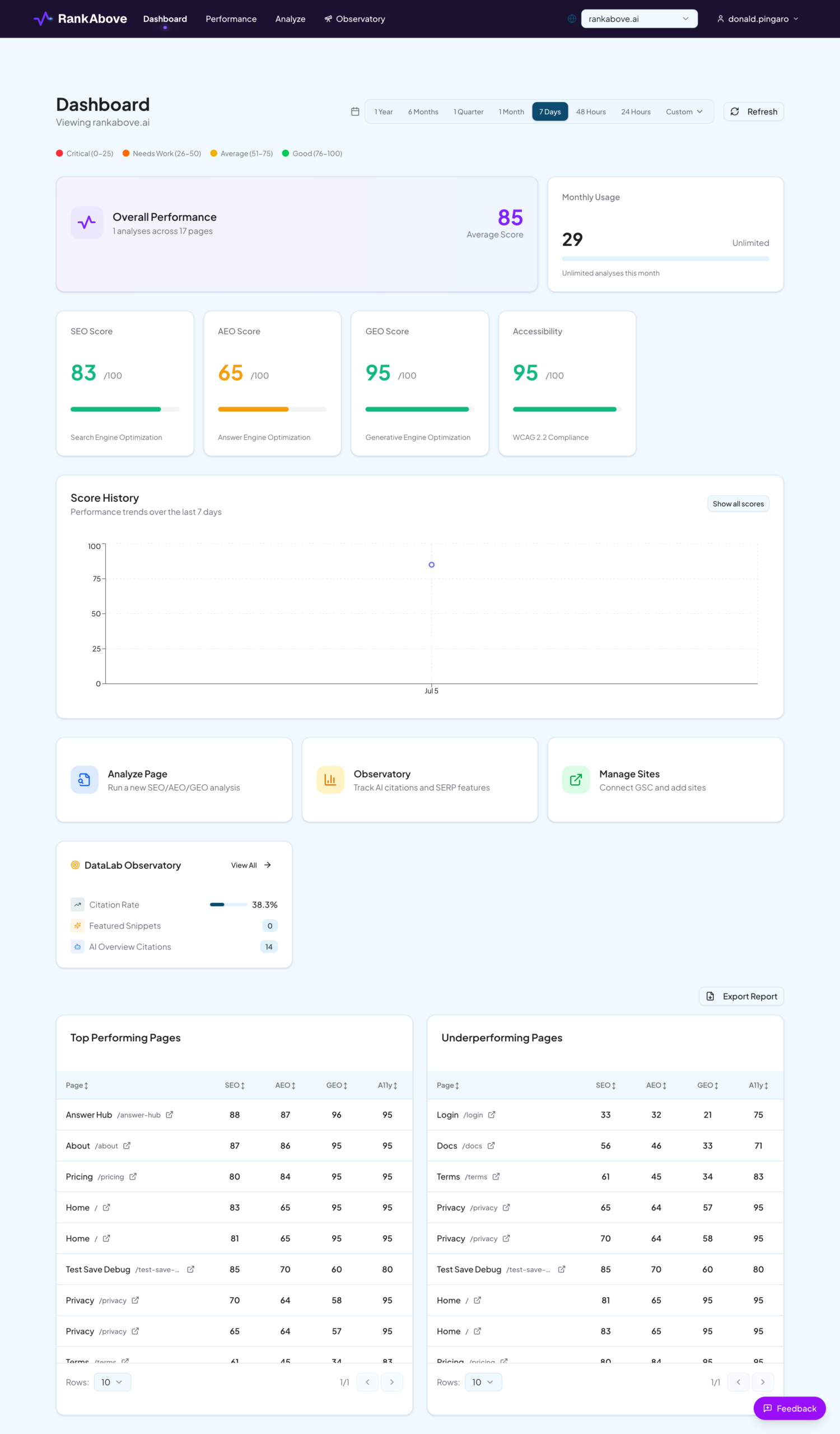
The Overall Performance card blends your four pillar scores, SEO, GEO, AEO, and accessibility, across every page you have analyzed (shown as, for example, "1 analyses across 17 pages"). Above 80 is fundamentally healthy; below 60 means gaps are actively costing you visibility.

The date range selector

At the top of the dashboard, a date range selector (1 Year, 6 Months, 1 Quarter, 1 Month, 7 Days, 48 Hours, 24 Hours, or a Custom range) controls every card and chart on the page at once, and lines up with the date ranges available in connected tools like Google Search Console, Google Analytics 4, and Bing Webmaster Tools. Changing it re-scopes the whole dashboard, not just one card.

Monthly usage and plan

The Monthly Usage card shows how many page analyses you have used this month against your plan's allowance, so you always know how much runway you have left before your next billing cycle.

The four score cards

Each card shows the site-level score for one layer, labeled with what it actually measures: SEO (Search Engine Optimization), AEO (Answer Engine Optimization), GEO (Generative Engine Optimization), and Accessibility (WCAG 2.2 compliance). Scores are color-banded the same way everywhere in RankAbove: Critical 0 to 25, Needs Work 26 to 50, Average 51 to 75, Good 76 to 100. Read the cards together: strong SEO with weak GEO means you rank but are not cited. Full breakdown of the scores.

Score History

The Score History chart plots your average score over the selected date range, so you can see whether a month of optimization work actually moved the needle. Tap "Show all scores" to break the single trend line into all four pillars at once.

Quick links and the DataLab Observatory widget

Three shortcut cards, Analyze Page, Observatory, and Manage Sites, jump straight to the workflows you use most. Beside them, a DataLab Observatory widget surfaces your citation rate, featured snippet count, and AI Overview citations without leaving the dashboard; tap "View All" to open the full Observatory.

Top and Underperforming Pages

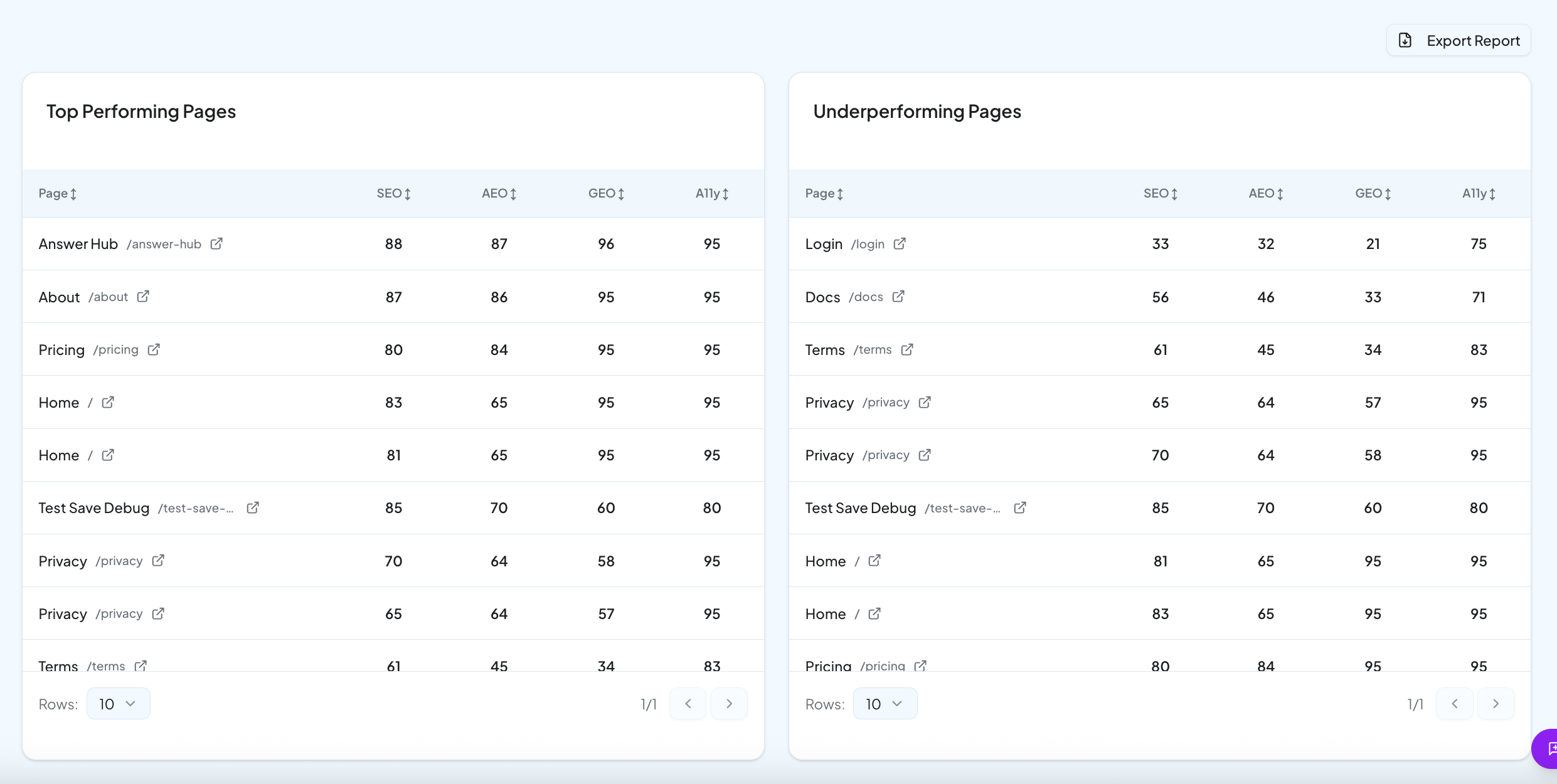
At the bottom of the dashboard, two tables list your Top Performing Pages and Underperforming Pages, each with per-page scores across all four layers, plus an "Export Report" button for sharing the data outside RankAbove.

Use the Underperforming list as your guide for what to work on next: the lowest-scoring pages have the most room to grow. Identify the pages in that list that matter most to your brand's goals, and prioritize those first rather than working strictly bottom-up. The full prioritization framework.

What to check each week

A useful weekly loop takes five minutes: glance at the overall score for movement, scan the four cards for a layer that slipped, and check whether any page has entered the Underperforming list. Deeper investigation belongs in the Observatory and the Performance page, not the dashboard.

Good to know

Scores recalculate when you run analyses, so a quiet dashboard usually means it is time to start the next monthly cycle, not that nothing is wrong.

Search fundamentals

SEO

Search Engine Optimization: earning a high position in the ranked list of links a search engine returns.

SERP

Search Engine Results Page: the page of results Google or Bing shows for a query.

Impressions

The number of times your page appeared in search results, whether or not it was clicked.

CTR

Click-through rate: clicks divided by impressions. Measures how appealing your result is when shown.

Average position

Where your page ranked, on average, when it appeared for a query.

E-E-A-T

Experience, Expertise, Authoritativeness, Trust: the quality signals search engines use to judge sources.

AI search terms

LLM

Large language model: the AI systems behind ChatGPT, Claude, Gemini, Perplexity, and Grok.

GEO

Generative Engine Optimization: making your content likely to be cited when an AI engine composes an answer.

AEO

Answer Engine Optimization: making your content likely to be used as the single direct answer.

AI Overview

The AI-generated summary Google shows above traditional results on many searches.

Citation

An AI engine referencing your site as a source inside a generated answer.

Citation share

The portion of relevant AI answers that cite your site, your market share inside AI answers.

Citation density

How many self-contained, quotable statements a page offers that an engine can lift directly.

Structured data / schema

Machine-readable markup (like JSON-LD) that lets engines parse your entities, products, and facts.

RankAbove terms

DataLab

RankAbove’s citation intelligence engine: it queries the AI platforms daily, tracks Google SERP features weekly, and records who gets cited.

Observatory

The insights page where citation rates, top pages, trends, and tracked prompts live.

Performance page

Clicks, impressions, CTR, and position for your pages, drawn from Google Search Console.

Page rule

A plain-language instruction (voice, audience, language) applied to all optimizations for a page.

The eight pillars

The citation factors RankAbove scores: accuracy, authority, structure, density, depth, E-E-A-T, freshness, clarity.

30-day cycle

RankAbove’s recommended monthly rhythm: analyze, optimize, deploy, then measure for 30 days.

Tip

New teammates: read "SEO vs GEO vs AEO, explained" next; it connects these terms into one picture.

The selection process

When an AI engine answers a question, it retrieves candidate pages, evaluates them, and composes a response from the few it trusts. Every cited source wins brand presence inside the answer; everything else is invisible. The evaluation weighs authority, factual precision, structure, and how easily a passage can be lifted whole.

Engines differ

Citation patterns differ sharply by engine. Some lean on their search index and favor freshness; others weight domain authority or well-structured reference content. Optimizing for one engine does not guarantee the others, which is why RankAbove's DataLab monitors them separately and reports citation share per engine.

The signals that travel

Four signals consistently separate cited pages from ignored ones with equivalent rankings: structured data, citation density (self-contained, quotable statements), factual precision (figures, dates, named entities), and source clarity (unambiguous authorship and organization identity).

Good to know

Traditional ranking position explains less than half of citation behavior. Strong SEO gets you into the candidate set; these signals get you chosen.

Citations compound

Engines return to sources that have served them well, and cited pages accumulate authority signals that make future citations more likely. That makes citation share winner-take-most, and makes early, systematic citation work disproportionately valuable.

The shift

When Google shows an AI Overview, the generated answer sits above the traditional links, and it satisfies many searchers before they ever scroll. Click-through rates for the top organic positions drop sharply when an Overview is present. Ranking first no longer guarantees the visit.

The new unit of visibility

Inside an Overview, visibility belongs to the cited sources, the handful of pages the AI drew from. Being one of them puts your brand inside the answer; being absent makes even a first-place ranking invisible for that query. Citation share is becoming as important as rank.

How to measure the impact

Watch for the signature pattern in your Performance page: impressions holding steady while clicks decline. That usually means Overviews are absorbing clicks on queries you still rank for. Then check the Observatory: if you are not being cited on those queries, that is the gap to close.

Why it matters

A falling CTR with stable rank is not an SEO failure, it is a GEO gap. The fix is citation-oriented content work, not more keywords.

How to respond

Identify your highest-value queries where an Overview appears, analyze the relevant pages, and prioritize the citation-factor recommendations: quotable statements, structured data, and factual precision. The goal shifts from winning the click to being in the answer, and capturing the clicks that remain.

SEO: being ranked

Search Engine Optimization is the classic discipline: earning a high position in the list of links Google and Bing return. It rewards relevance, authority, internal linking, page speed, and keyword coverage. SEO still matters, it is how engines find and evaluate you in the first place.

GEO: being cited

Generative Engine Optimization is about being used as a source when an AI engine like ChatGPT, Claude, Gemini, or Perplexity composes an answer. The engine reads many pages and cites a few. GEO rewards factual density, quotable statements, clear sourcing, and structured data, the signals that make your content easy to lift into an answer.

AEO: being the answer

Answer Engine Optimization targets the single direct response: the featured snippet, the AI Overview summary, the one-line assistant reply. AEO rewards concise definitions, question-shaped headings, and schema, content shaped so an engine can answer with it verbatim.

Why you need all three

The same page serves all three layers, but a page can win one and lose the others: ranked first yet never cited, or cited by AI while invisible in traditional results. That is why RankAbove scores the three side by side, and why fixing the weakest layer usually delivers the fastest visible gain.

Rule of thumb

SEO gets you considered. GEO gets you quoted. AEO gets you to be the answer itself.

Requesting access

Visit www.RankAbove.ai and click "Request Access" in the top right. Fill in your name, email, and company details, and tell us how we can help. Our team reviews every request personally.

Good to know

Approval usually comes the same day. You will receive an email with login instructions once your request is approved.

What happens during approval

We review your company details to set up the right workspace: your industry vertical shapes the citation benchmarks DataLab compares you against, and your domain is pre-registered so your first site connection is faster.

Logging in for the first time

Follow the link in your approval email, set your password, and you will land on the RankAbove dashboard. Before running your first analysis, connect Google Search Console; it is required for accurate data. The Welcome to RankAbove guide walks through the full setup step by step.

Adding teammates

Each teammate requests access with the same company name, and our team links them to your workspace during approval. Everyone shares the same sites, integrations, and analysis history.