RankAbove logo — purple pulse-line mark with animated teal dot, next to white 'rankabove' wordmark

Most onboarding issues can be resolved without restarting setup. Find the message or situation you see below, then follow the recommended steps.

If your message is not listed here, contact your RankAbove account owner or support.

Welcome email link expired

Ask RankAbove or your workspace administrator to send access again. Use the newest welcome email when you return to the sign-in page.

Wizard appears again after refresh

Finish any remaining onboarding steps. On the final screen, choose Start Analysis or Skip. Keep the tab open while a step is processing.

No verification email

  1. Wait a few minutes.
  2. Check your spam or junk folder.
  3. Select Send new code.
  4. Enter the newest code within 30 minutes.

You skipped Google or your sitemap

You can continue. RankAbove can still analyze the URL you added. Connect Google Search Console, Google Analytics, or your sitemap later in Settings > Integrations.

Invited member is asked to create an organization

Stop before creating a second workspace. Invited members should join the organization their administrator already created. Contact your RankAbove account owner or support for help.

Observatory is empty on day one

Allow the first scheduled data runs to complete. AI citation tracking runs daily at 4:00 AM UTC, and search presence data runs daily at 5:00 AM UTC. Check Observatory again after those runs.

Still need help?

Contact your RankAbove account owner or support and share the exact message you see.
Understanding DataLab and Observatory

DataLab is the measurement system behind RankAbove’s Observatory. It collects recurring search and citation data so you can see how your site appears across traditional search and AI answer engines.

What DataLab does

DataLab runs scheduled checks for your organization’s sites. Observatory is where you review the results, including AI citations, Google search features, organic position, and AI-referred traffic when the relevant Google connections are active.

Allow at least one daily run after adding a site before expecting a complete Observatory picture.

What DataLab measures

Measurement Schedule What you see
AI citation tracking Daily at 4:00 AM UTC Whether ChatGPT, Claude, Brave, Perplexity, Gemini, and Grok cite your pages.
Search presence Daily at 5:00 AM UTC Featured snippets, People Also Ask, AI Overviews, and organic position.
Google Search Console sync Daily at 6:00 AM UTC GSC search data when the site is connected.
Google Analytics referrals Daily at 6:30 AM UTC AI-source traffic in Observatory when GA4 is connected.
Scoring weights Monthly on the first day at 3:00 AM UTC DataLab adjusts GEO pillar weights using measured citation outcomes.

Connections and what they add

  • Site URL: Lets Analyzer score the site and allows Observatory to begin daily citation tracking.
  • Sitemap: Helps RankAbove find and list pages, especially when GSC is not connected.
  • Google Search Console: Adds richer search data to the dashboard and page analysis.
  • Google Analytics: Adds traffic and AI-referral views to Observatory.

You can add or update these connections after onboarding in Settings > Integrations.

How to read the results

  1. Choose the site you want to review in Observatory.
  2. Check whether your pages are being cited across the supported AI engines.
  3. Review search presence for featured snippets, People Also Ask, AI Overviews, and organic position.
  4. If GA4 is connected, compare AI-source traffic with changes in visibility.
  5. Use Analyzer recommendations to plan corrections, then make those changes in your CMS.

What is not available yet

DataLab measures performance, but RankAbove does not currently publish or roll back CMS changes for you. Apply recommended corrections in WordPress, Shopify, Magento, or your other CMS, and use that platform’s revision history when you need to restore an earlier version.

  • There is no client-facing Clarity “AI Bot Crawls” screen yet.
  • Bing Webmaster Tools cannot currently be connected in onboarding or Settings.
  • Grok is already included in citation tracking. It is not marked as coming soon.

If Observatory is empty

If you added the site today, wait for the next citation run at 4:00 AM UTC and the next search presence run at 5:00 AM UTC. If data is still missing after the next scheduled run, confirm your site and Google connections in Settings, then contact your RankAbove account owner or support.

RankAbove uses your site’s real search performance to produce recommendations you can trust. That is why every account must connect GSC (Google Search Console) before running an analysis. GSC gives RankAbove the context it needs to evaluate SEO, GEO, and AEO together.

What is ground truth?

Ground truth is the trusted, first-party record used as the baseline for an analysis. In RankAbove, GSC data is ground truth because it shows the actual Google queries that cause your pages to appear in search, along with impressions, clicks, page performance, and changes over time. It replaces guesses with evidence from your own site.

Why RankAbove requires GSC

Connecting GSC gives RankAbove a reliable starting point for every recommendation. It helps the platform:

Why page text and trend data are not enough

Page content and broad trend data can suggest useful topics, but they cannot show how your specific site performs. Without GSC, keyword context can be incomplete, and that missing input can weaken the analysis that follows. RankAbove requires GSC so it does not present estimates as dependable recommendations.

How GSC supports SEO, GEO, and AEO

For SEO, GSC shows how people discover your pages in Google. RankAbove uses that same verified query and page context when evaluating GEO and AEO visibility across AI-powered search and answer surfaces. This creates one consistent foundation for diagnosing issues, recommending changes, and measuring results.

Connect GSC before your first analysis

Use a Google account that has access to your site’s GSC property, then connect it during the RankAbove onboarding process. Once the connection is complete, RankAbove can use your real search data to deliver more relevant recommendations for your home page and any other pages you choose to analyze.

Next step

Connect Your Site

Follow the step-by-step guide to connect your website and prepare RankAbove for your first analysis.

Open Connecting Your Site →

Built on the opposite premise

We started with a peer-reviewed baseline: the Generative Engine Optimization research published at ACM KDD 2024. That gave us a scientifically grounded framework for what should drive AI citations. We treat that paper as a hypothesis, not gospel, and continually retest its recommendations against current evidence.

DataLab tests the framework against measured citation data and re-anchors it wherever the evidence disagrees. Pre-registered hypotheses, real significance thresholds, and corrections for multiple comparisons bring the scientific method to search optimization.

The data that powers it

When a page is analyzed, it enters the tracking pool. RankAbove assembles real search queries anchored in the Google searches the page already receives, runs those queries against major AI engines with live web search enabled, and reads the structured sources each engine reports using.

We match your domain exactly against those sources. A mention without a source is recorded separately and is never counted as a real citation.

A citation rate you can watch

The result is a per-page, per-engine citation rate you can monitor over time: improve your content, then measure whether answer engines begin citing it.

A real statistical bar

We hold our own findings to a real statistical standard before showing them to clients. Until a finding clears that bar, we treat it as unproven, internally and externally.

Our standard

Nothing is shown in RankAbove unless it meets our significance standards. No one should change content strategy on a whisper.

How this page works

Each entry below covers one release: what shipped, what changed, and anything you need to do. Entries are dated and listed newest first. During beta, releases are frequent; if something you use changes behavior, it will be noted here.

For whoever maintains this page

This list is generated from a single data file, not hand-built HTML. Adding a release means adding one entry to that file, not editing a page. If your team wants a staging-to-production push to append an entry automatically, that entry can come from a release bot or CI job instead of a person.

Release log

Have a request?

Feature requests go through the purple Feedback button in the bottom right corner of any RankAbove page within the app. Beta feedback genuinely shapes the roadmap.

Setup and access

RankAbove is in beta and access is granted by request. Visit www.RankAbove.ai, click "Request Access", and fill in your details. Approval usually comes the same day, by email.

Yes. RankAbove requires GSC to provide accurate data and recommendations. Google Analytics 4 is optional but recommended; it adds traffic context that makes recommendations more specific.

Yes, during beta. Click "Advanced" in the bottom left of the warning screen and proceed. A message confirms when the connection is complete.

The optimization workflow

No. Nothing publishes without explicit approval from a designated human reviewer. Every change is logged, and every deployment can be rolled back with one click.

One batch per page per month, typically 3 to 5 changes. Too many changes inside a 30-day window risks a Google penalty for churn and makes results unreadable.

Judge each cycle on a full 30-day window. Impressions move first, then clicks and CTR. Position improvements typically show within two to four weeks of deployment.

WordPress, Shopify, Drupal, Adobe Experience Manager, Adobe Commerce, and Magento, via the Integrations tab in Settings. For other platforms, generated content can be reviewed and pasted manually.

AI visibility

ChatGPT, Claude, Gemini, Perplexity, and Grok, plus Google AI Overviews. Citation patterns differ by engine, so each is monitored separately.

RankAbove checks brand queries every 24 hours and alerts you the same day a discrepancy appears, with the query, the engine, and the recommended fix. Accuracy fixes can deploy immediately; they are the exception to the monthly cadence.

No. RankAbove reads your GSC and GA4 data during analysis; your data stays in your Google account.

Still stuck?

Tap the purple "Feedback" button in the bottom right corner of any RankAbove page, or browse the Help Articles in the left navigation.

The Feedback button

Tap the purple "Feedback" button in the bottom right corner of any page. Questions, comments, and bug reports all go through the same channel, and the team gets back to you right away.

Writing a useful bug report

Three things make a report actionable: what you did (the page and the action), what you expected, and what happened instead. Include the site and page URL involved; if the problem is visual, a screenshot saves a round trip.

Tip

If an analysis fails or returns something strange, note the exact page URL you analyzed and the approximate time. That lets the team find the run in the logs directly.

Feature requests

Feature requests go through the same Feedback button. Beta feedback genuinely shapes the roadmap, so describe the problem you are trying to solve rather than only the feature you want built.

Self-serve help

The Help Articles in the left navigation cover setup, the analysis workflow, integrations, and results. For everything else, check www.RankAbove.ai/support or reach out through the Feedback button.

Plans at a glance

RankAbove has five tiers, priced by monthly page-scan allowance and team seats:

Good to know

Pricing and allowances shown here reflect what is published at rankabove.ai/pricing. Check that page for the current numbers before quoting a customer.

What every plan includes

Every tier, Freelancer through Enterprise, includes the same full feature set. Plans differ only by page-scan allowance and team seats, not by capability:

Enterprise-only features

A handful of capabilities are reserved for Enterprise, on top of unlimited page scans and custom team seats:

Billing cycles and savings

Every plan can be billed monthly, quarterly (save 5%), every 6 months (save 10%), or annually (save 15%). At the annual rate: Freelancer drops from $50 to $42.50/mo ($90/yr saved), Starter from $250 to $212.50/mo ($450/yr saved), Plus from $750 to $637.50/mo ($1,350/yr saved), and Pro from $2,000 to $1,700/mo ($3,600/yr saved).

Free trials and getting started

Freelancer includes a 14-day free trial with no credit card required. Starter, Plus, Pro, and Enterprise all require a credit card to start. If a trial ends without upgrading, the account moves to a read-only state and its data is retained for 30 days.

Page limits and overages

RankAbove does not charge automatic overages. You're notified at 80% and 100% of your plan's monthly page-scan allowance, then you can upgrade your plan or free up capacity by removing pages from active tracking.

On Team plans, the Admin has additional control here: they can allocate a page-analysis budget per team member, and choose whether to allow or deny a member's requests for extra analyses beyond their allocation. See Managing users and roles.

Upgrading, downgrading, and cancellation

Only the Admin, the first account created on an instance, can add, change, or remove the billing card, upgrade the plan, downgrade it, or cancel the account. This is the same restriction that governs team management and integrations; see Managing users and roles for the full breakdown of what the Admin controls.

Exporting from the Dashboard

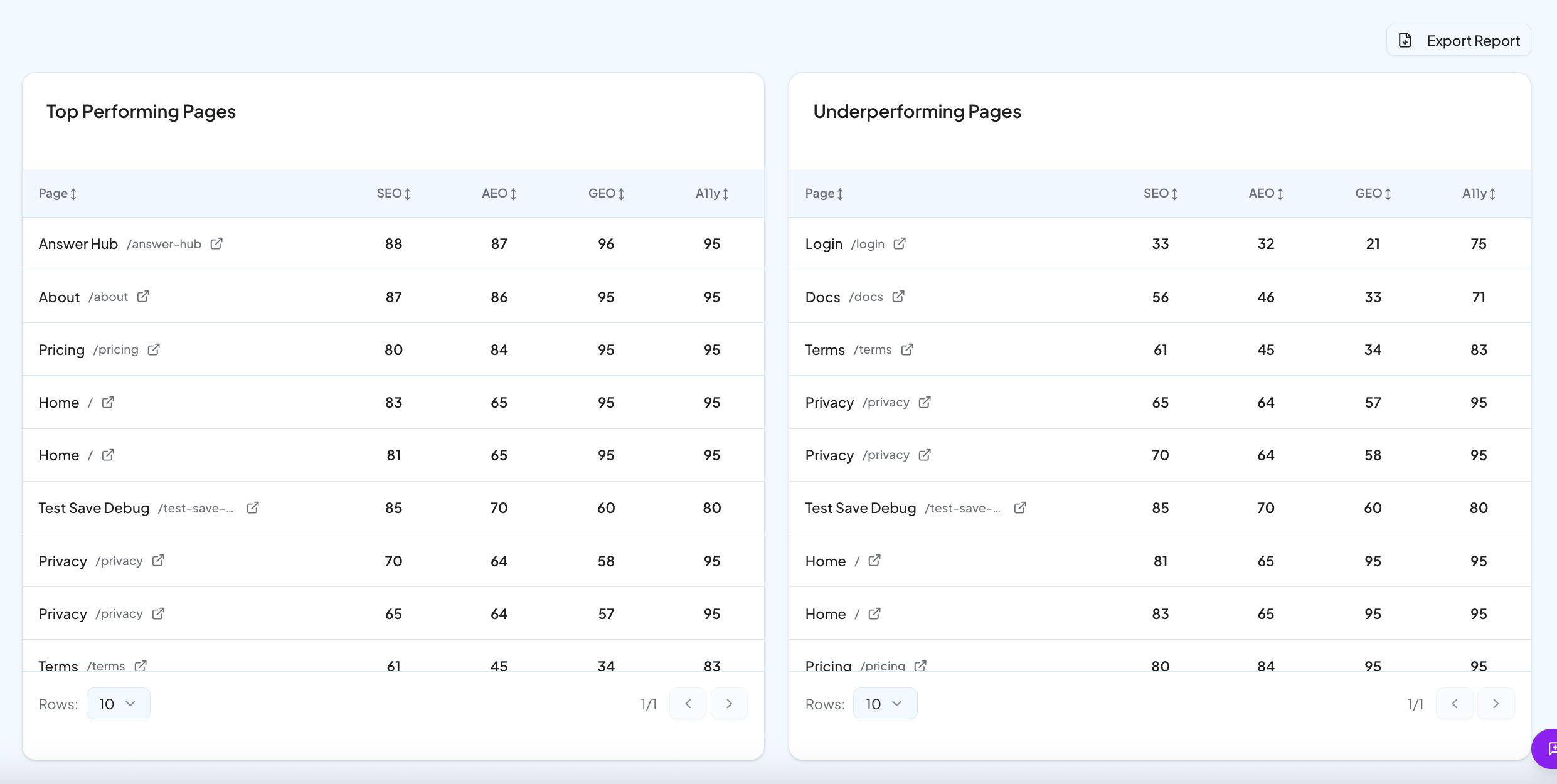
Above the Top Performing Pages and Underperforming Pages tables on your Dashboard, an "Export Report" button exports those page lists, with every page's SEO, AEO, GEO, and accessibility scores, for sharing outside RankAbove.

This is the fastest way to hand a stakeholder the current state of the site without giving them a login. See Reading your dashboard for what the rest of the page shows.

Exporting from the Optimizer

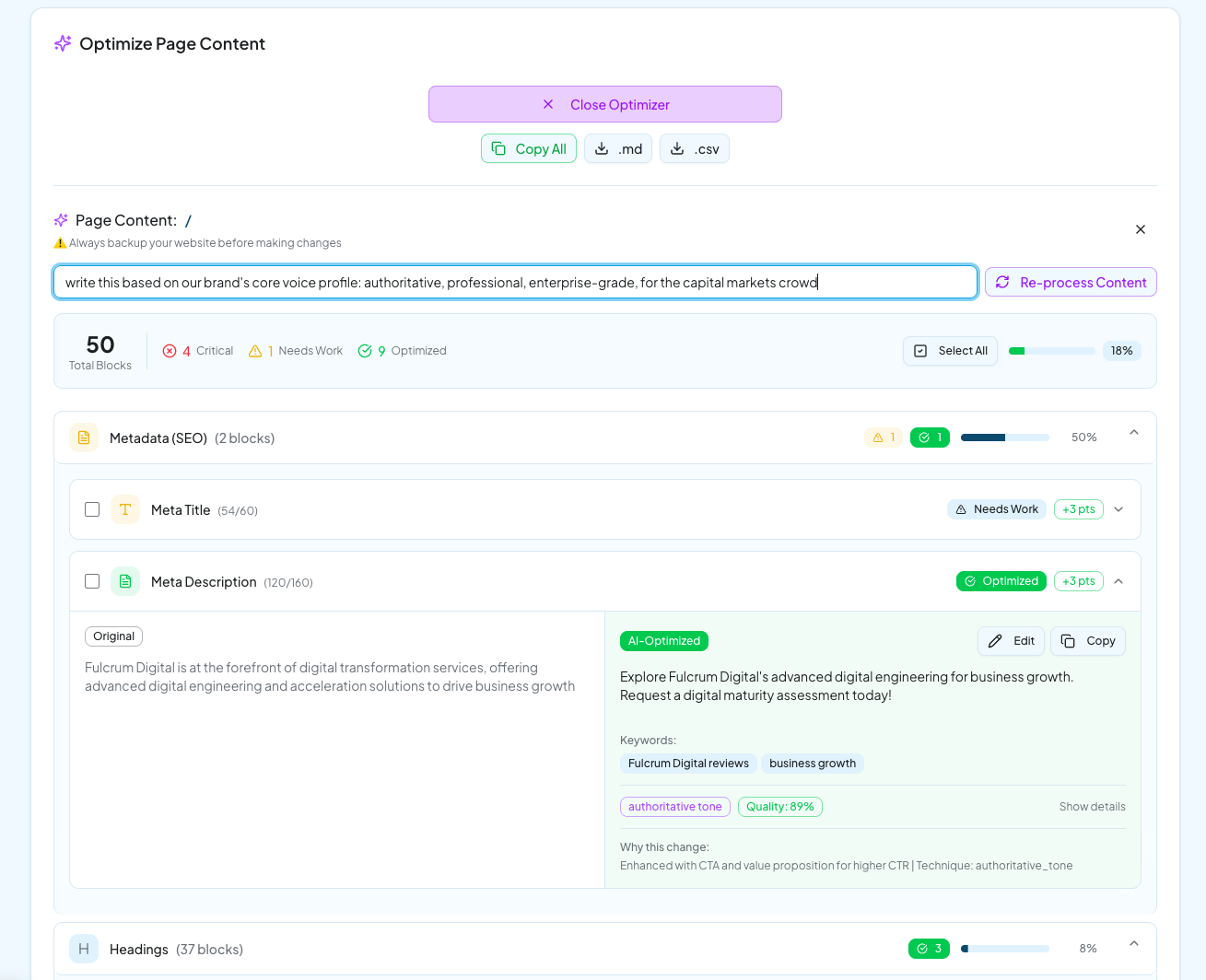
Inside the content optimizer, “Copy All,” .md, and .csv sit at the top of the panel, next to “Close Optimizer.” They export every recommendation on the page, Original and AI-Optimized text side by side, for teams that review or apply changes outside RankAbove.

RankAbove Optimize Page Content panel with Copy All, .md, and .csv export buttons at the top

Full detail on what's in each block lives in Optimizing page content in the editor.

Choosing a format

Copy All is fastest for pasting straight into a CMS or a doc. .md keeps headings and structure intact, a better fit for a wiki or a written brief. .csv opens as a spreadsheet, the right choice when a content team wants to sort, filter, or track recommendations in a shared tracker.

Using exports together

A common pattern: export the Dashboard's page lists as a monthly stakeholder update, and export a page's optimizer recommendations as .csv when handing that page's changes to a writer who doesn't have a RankAbove seat. Both exports reflect the same scores and recommendations you'd see in the product, just outside it.

The four core metrics

Clicks counts visits from search results. Impressions counts how often you appeared. CTR is the ratio between them, and average position is where you ranked when you appeared. Together they tell you whether a change moved discovery, appeal, or both.

Reading movement after a change

Impressions respond first: better rankings and new citations put you in front of more searches. Clicks and CTR follow as searchers (and AI engines) choose you more often. Position improvements typically show within two to four weeks of a deployed change.

Best practice

Judge each optimization cycle on a full 30-day window. Comparing a few days before and after a change mostly measures noise.

Pairing Performance with the Observatory

Performance shows traditional search results; the Observatory shows AI citations. A page can gain citations without gaining rank, so check both before deciding whether a change worked. The combination is the full picture of findability.

Using it for reporting

The Performance page is built for the monthly cycle: run your analysis, deploy approved changes, wait 30 days, and screenshot the deltas for your report. Every metric is drawn directly from Google Search Console, so numbers match what your SEO team already reports.